
The FTP test: a recommended setup, and what a failed attempt shows
Most failed FTP tests are not a fitness problem. They are a setup problem: the wrong target, carried over from the wrong device, paced from the first minute as if the number were already true.
Functional threshold power (FTP) is the highest power a cyclist can hold in a quasi-steady state for roughly an hour. Almost nobody tests it by riding for an hour. The standard shortcut is a 20-minute all-out effort, with FTP set at 95% of the 20-minute average. Every zone in a structured plan hangs off that one number, which is why a test that goes wrong costs more than one bad morning.
What the 20-minute test actually estimates
The 95% rule holds up on average and drifts on the individual. Borszcz and colleagues tested 23 trained cyclists in 2018: 20-minute FTP, 60-minute FTP and the individual anaerobic threshold were not different as group means, and the bias was small (1 to 5 W). The limits of agreement were wide, though, up to roughly 60 W either side, and the time riders could actually hold their 20-minute FTP ranged widely around a mean of 50.9 minutes. The authors' conclusion: the two numbers should not be used interchangeably for one person.
The practical reading is that a 20-minute FTP is a training anchor, not a physiological constant. It is good enough to set zones. It is not precise enough to treat a 5 W change as signal.
The three common protocols
- 20-minute test: warm up, ride 20 minutes as hard as you can sustain evenly, take 95% of the average. Closest to the sustained effort FTP describes, and the hardest to pace.
- Ramp test: power rises in one-minute steps until failure. Training platforms set FTP at about 75% of the best one-minute power. Easy to pace and repeat, but riders with a big anaerobic capacity get an inflated number.
- 8-minute test: two 8-minute efforts with recovery between, FTP at 90% of the better effort. Shorter, and more dependent on how well the rider tolerates high intensity.
The recommended setup below is written for the 20-minute version, because that is the protocol where setup errors cost the most.
Worked example: a 20-minute test that failed at 7:11
The file below is the editor's own indoor session on October 24, 2026, ridden on a Technogym bike with a Garmin recording. The workout was built off a 275 W FTP, which put the 20-minute target at 289 W (275 divided by 0.95). The warm-up was 10 minutes easy, three 1-minute efforts at about 305 W with 1 minute easy between, then 9 minutes easy before the test block.
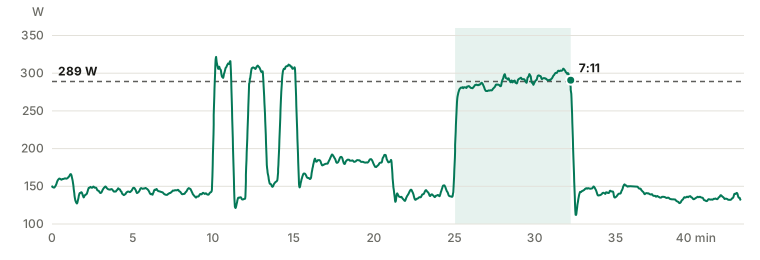
The power held. The test lasted 7 minutes 11 seconds at an average of 289 W, exactly on target, at a steady 90 rpm. The minute-by-minute numbers even rise, from 280 W in the first minute to 302 W in the seventh. Nothing in the power trace says the rider was in trouble.
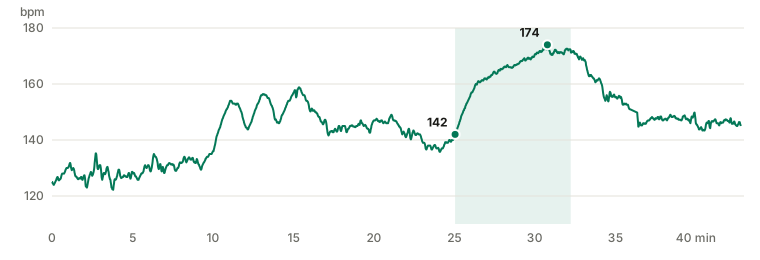
Heart rate tells the real story. It climbed 32 bpm in under six minutes, then flattened at 172 to 174 bpm with more than 12 minutes still to go. A heart rate that plateaus near its ceiling this early in a 20-minute effort means the rider is above threshold and paying for it from anaerobic reserves. The effort was not going to last, and it did not.
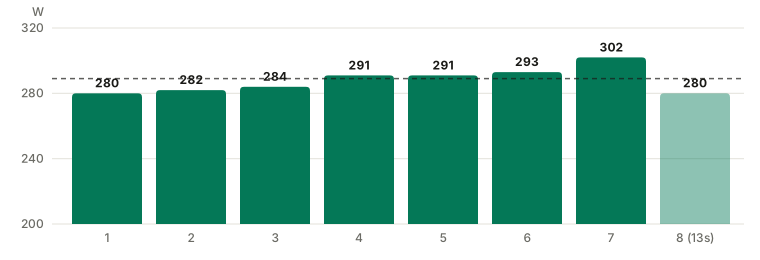
| Minute | Power (W) | Avg HR (bpm) | Cadence (rpm) |
|---|---|---|---|
| 1 | 280 | 150 | 91 |
| 2 | 282 | 160 | 90 |
| 3 | 284 | 164 | 91 |
| 4 | 291 | 166 | 89 |
| 5 | 291 | 169 | 89 |
| 6 | 293 | 172 | 90 |
| 7 | 302 | 172 | 91 |
The likely cause is the starting number, not the legs. The 275 W FTP came from earlier training, and power readings differ between devices: a gym bike, a smart trainer and a pedal power meter can disagree by several percent on the same effort. A target that was realistic on one device can be above threshold on another. The provisional fix after this test: set FTP to 248 W on the Technogym bike, and retest in the week of October 26 with the test block opening at about 255 W.
Recommended setup for a 20-minute FTP test
- Test on the device you train on. An FTP is only valid for the power source that measured it. If the bike changes, treat the old number as unknown and test again before setting zones.
- Keep the warm-up short and familiar. Barranco-Gil and colleagues (2020) compared the standard 45-minute FTP warm-up, a 10-minute easy warm-up and no warm-up in 15 trained cyclists. The relationship between FTP and the respiratory compensation point did not depend on which warm-up was used. Ten to fifteen minutes easy with two or three short openers is enough.
- Open below the target. Ride the first five minutes at about 95% of the goal power. In the example above, that would have meant about 275 W instead of 289 W for the opening block. Hold, then raise the target in the last five minutes if heart rate and breathing allow it.
- Watch heart rate for the first five minutes. If it is already within a few beats of your known maximum by minute five, the target is too high. Back off 5 to 10 W immediately rather than waiting for the legs to decide.
- Come in fresh. For a hybrid athlete that means no heavy lower-body lifting and no hard running in the 48 hours before the test, since leg fatigue from strength work shows up as early failure on the bike. The interference effect is small over a training block, but acute fatigue on test day is not.
- Control the room. A fan aimed at the torso, the same time of day as the last test, and the same pre-test meal. Heat raises heart rate at the same power and makes the result look worse than the fitness.
What to do after a failed test
Do not restart the test the same day. The effort already spent makes a second attempt slower than the first, and the number it produces will be too low. Set a provisional FTP below the old one, a conservative estimate that is clearly sustainable, train on it for a week, then retest with an opening target near that provisional number. A test that ends with a rider raising the power in the final five minutes produces a better number than one that starts too high and stops early.
The shorter version: pick the device, pick a target you can hold for five minutes without heart rate hitting the ceiling, and only then try to find out how much more there is.
FAQ
- How do you calculate FTP from a 20-minute test?
- Multiply the average power of the 20-minute effort by 0.95. A rider who averages 300 W for 20 minutes gets an FTP of 285 W. The 5% discount approximates the drop from a 20-minute to a 60-minute effort.
- What should you do if you fail an FTP test?
- Stop, cool down and do not retry the same day. Set a provisional FTP below the old number, train on it for a few days, and retest within one to two weeks with a lower opening target that you raise only in the last five minutes.
- Is a ramp test or a 20-minute FTP test more accurate?
- Neither is a lab measure. The ramp test is easier to pace and repeat, but it estimates FTP from one-minute power, so riders with a strong anaerobic capacity get an inflated number. The 20-minute test is harder to pace and closer to the sustained effort FTP is meant to describe.